
Driveways and parking lots across the Kansas City area
Asphalt Paving in Kansas City, MO
Pavement built from the subgrade up, shaped to shed water on hilly lots and timed around a long freeze season.
- Free on-site estimates with measurements
- Itemized written quote: base, thickness, edges
- Drainage and slope checked before any asphalt is laid
Paving for Hills, Clay and Freeze-Thaw Winters
Asphalt paving in Kansas City lasts as long as what is underneath it. The city averages freezing temperatures from about October 31 to April 4, gets roughly 38 to 39 inches of precipitation a year, and sits on rolling ground cut by creek valleys. Put those together and you get water running across pavement, soaking into the soil below, and freezing there. That cycle, repeated through a winter, is what turns a hairline crack into a pothole. A driveway or lot that is graded, based and drained correctly handles it far better than one with fresh asphalt laid over a weak base.
The ground under Kansas City pavement
Missouri's 1917 state geology of Jackson County describes the area's bedrock as interbedded limestone, shale and sandstone, with residual soil from that rock and a blanket of loess, a wind-deposited silty clay, across the northern part of the county. Upland soils of this type in the region, such as the Sharpsburg series mapped by USDA, carry roughly 33 to 42 percent clay in the upper subsoil. Soil like that holds water, softens when wet and moves when it freezes. We probe the existing surface for soft areas, dig out spots that pump or flex, and build up a compacted aggregate base before any asphalt goes down.
Hills and drainage
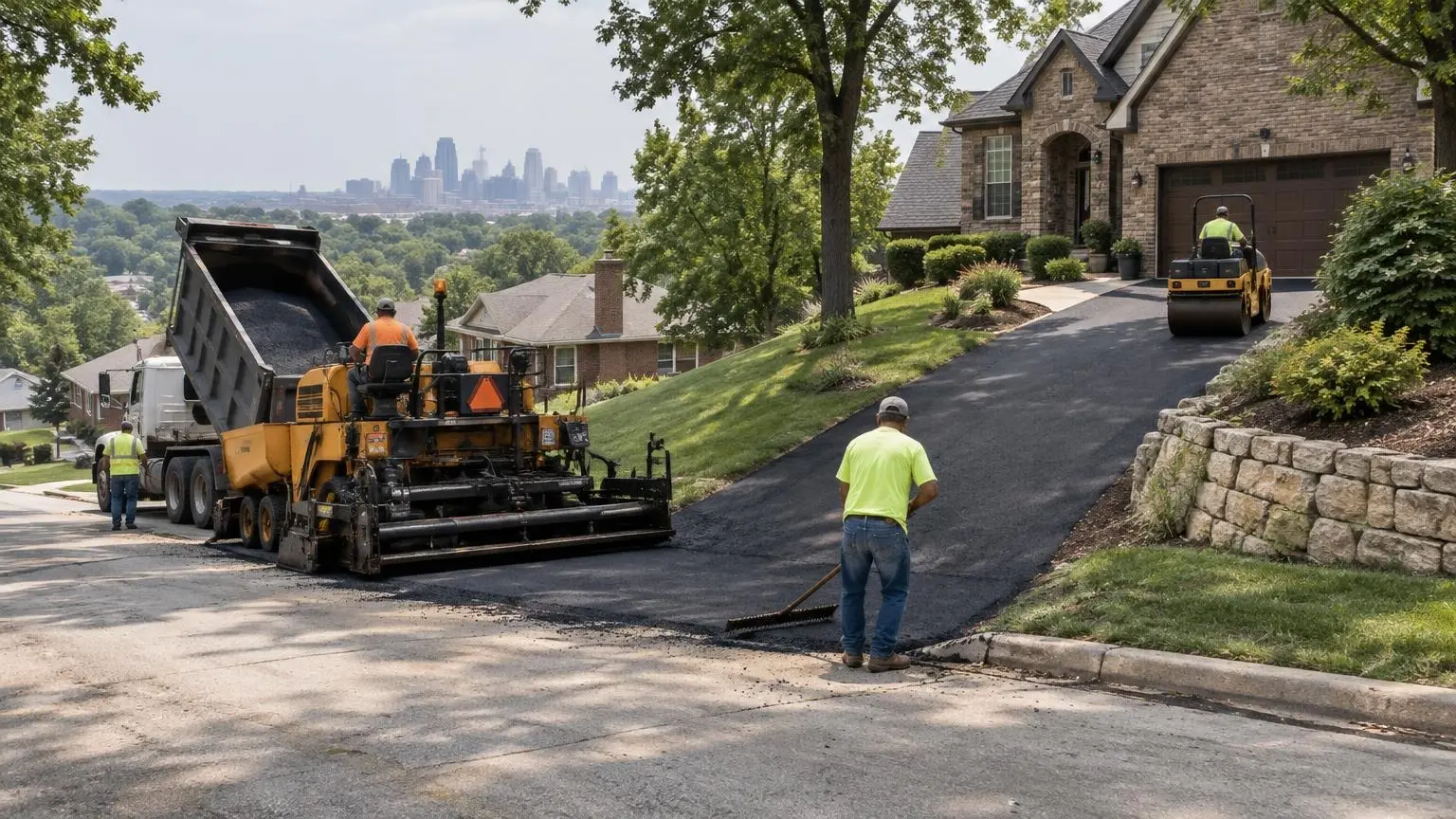
The same 1917 survey notes drops of 60 to 150 feet within five to eight blocks along Turkey Creek and the Blue River. Many Kansas City driveways climb or fall sharply from the street, and that changes the job. On a steep drive, water picks up speed and cuts along the edges; at the bottom it collects against the garage slab or the street. We set the finished grade so water has a planned path off the pavement, and where the existing slope sends water toward the house, we say so at the estimate instead of repaving the problem.
When asphalt can be laid
Rolling only works while the mix is still hot, and a cold subgrade drains that heat faster than cool air does. For Construction Pros reports that doubling a lift from 1.5 to 3 inches keeps it workable roughly four times longer, while wind speeds up cooling. In practice, new paving in Kansas City is easiest from spring through fall. Late-season jobs are planned around forecasts, and sealcoating needs warmer, dry days still, typically 50 to 95 degrees.
Permits at the street
Kansas City, Missouri splits a vehicle area into three parts: the drive approach (curb to property line), the driveway itself, and the parking space. The city's code questions page says the approach is the one piece that is permitted and inspected; the other two skip the permit but still have to satisfy Zoning and Development Code Section 88-420-012. If your project includes widening or replacing the approach, we raise it at the estimate so the permit is part of the plan. Neighboring cities handle approach work under their own codes.
What a new driveway job includes
- Measuring, checking slope and noting where water drains
- Removing old asphalt, concrete or gravel and hauling it away
- Digging out soft subgrade and grading for runoff
- Placing and compacting the aggregate base
- Laying hot-mix asphalt, commonly 2 to 3 inches for homes, and rolling it while hot
- Shaping the edges and tying in cleanly at the garage and the approach
- A walk-through with you and care instructions for the first weeks
Keeping pavement going
Most asphalt fails slowly and then quickly. Small cracks let water reach the base; the base softens; the surface breaks. Sealing cracks before winter, patching failed spots before they spread, and sealcoating every few years once the asphalt has cured are the cheapest ways to stretch the life of a driveway or lot. Published guides put asphalt life at roughly 15 to 30 years, and maintenance is a big part of where a surface lands in that range.
Our Asphalt Paving Services
Six services cover asphalt from new construction through the maintenance that keeps it from failing early.
Asphalt Driveway Paving
New and replacement asphalt driveways with the subgrade, base and slope worked out before the first load of hot mix.
Learn more →Parking Lot Paving
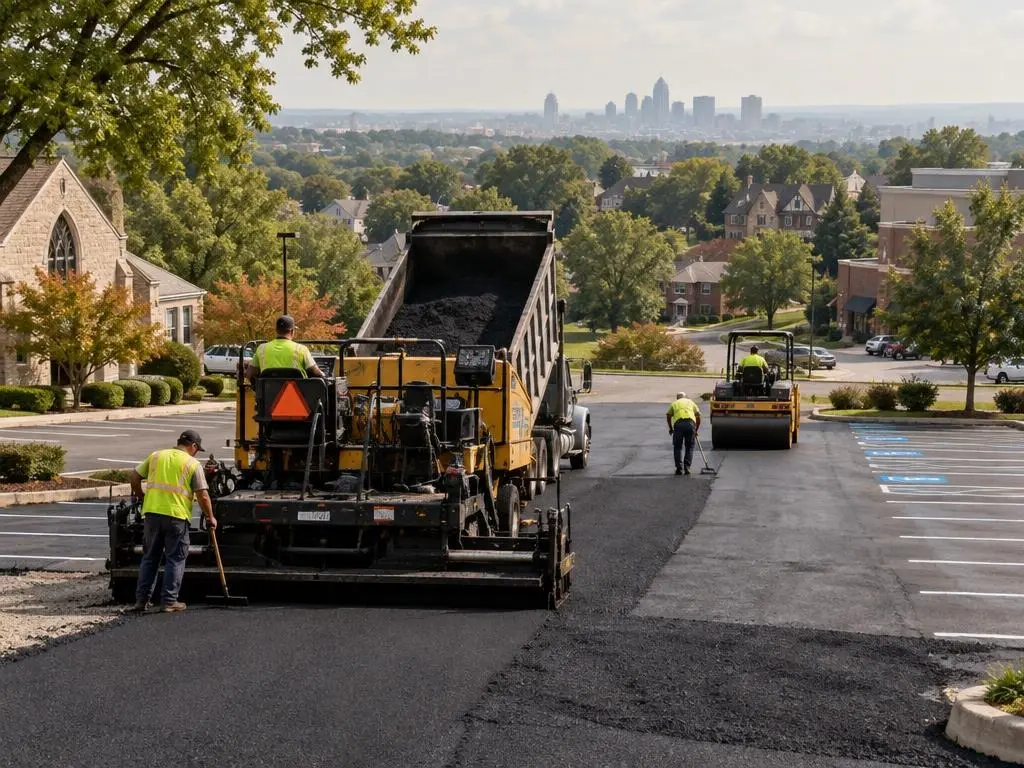
New lots, overlays and full reconstruction for churches, offices, retail and multifamily properties, planned around traffic and drainage.
Learn more →Sealcoating
A protective coat for cured asphalt driveways and lots, applied after cleaning and crack repair, on warm and dry days.
Learn more →Asphalt Repair & Patching
Potholes, sunken spots, crumbling edges and broken sections cut out and rebuilt so the damage stops spreading.
Learn more →Crack Sealing
Hot rubberized sealant placed in cleaned cracks so winter meltwater stays above the base.
Learn more →Line Striping
Parking lot striping and restriping, including accessible spaces, arrows, fire lanes and stenciling laid out to your plan.
Learn more →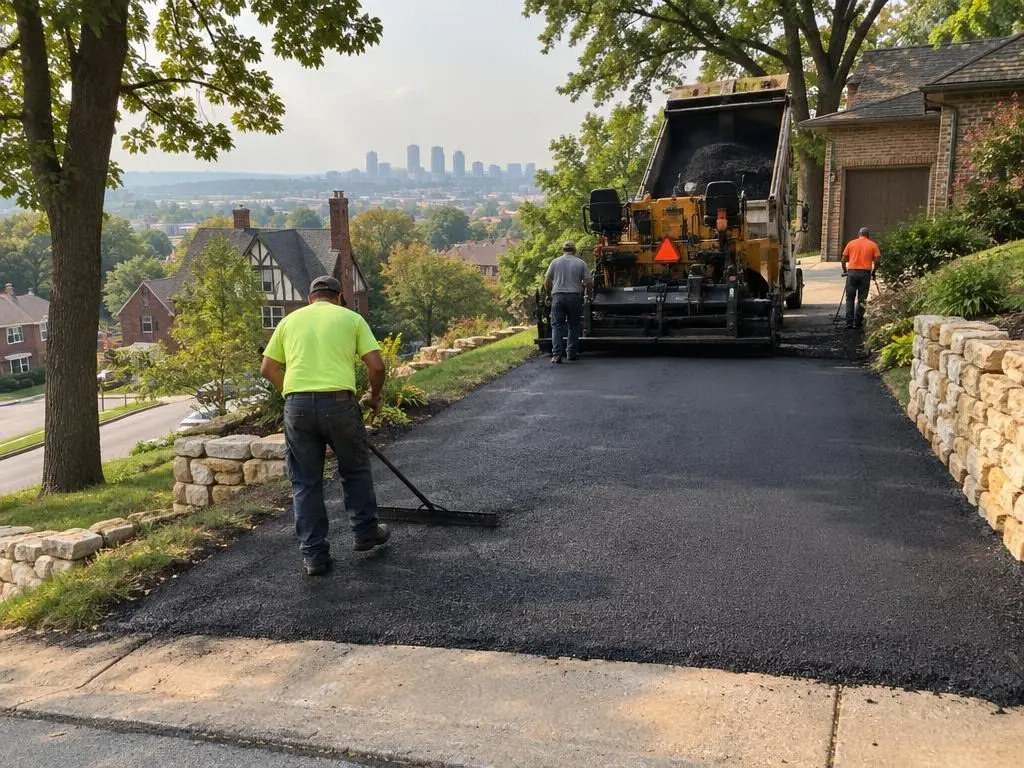
Where We Work
Kansas City, Missouri is the center of our service area, and the city itself is large: it spans parts of Jackson, Clay, Platte and Cass counties. On the Missouri side we also work in Independence, Lee's Summit, Blue Springs, Raytown, Grandview, Grain Valley, Belton, Raymore, Gladstone, North Kansas City, Liberty, Kearney, Smithville, Parkville and Riverside. Across the state line we serve Kansas City, Kansas and Overland Park. Each city sets its own rules for driveway approaches, curb cuts and work in the right-of-way, and older neighborhoods near the urban core tend to have steeper lots and tighter access than newer subdivisions in the Northland and eastern Jackson County. Town pages spell out the local details.
- Asphalt Paving in Kansas City, MO
- Asphalt Paving in Independence, MO
- Asphalt Paving in Lee's Summit, MO
- Asphalt Paving in Blue Springs, MO
- Asphalt Paving in Raytown, MO
- Asphalt Paving in Grandview, MO
- Asphalt Paving in Liberty, MO
- Asphalt Paving in Gladstone, MO
- Asphalt Paving in North Kansas City, MO
- Asphalt Paving in Parkville, MO
- Asphalt Paving in Riverside, MO
- Asphalt Paving in Belton, MO
- Asphalt Paving in Raymore, MO
- Asphalt Paving in Grain Valley, MO
- Asphalt Paving in Kearney, MO
- Asphalt Paving in Smithville, MO
- Asphalt Paving in Overland Park, KS
- Asphalt Paving in Kansas City, KS
Why Homeowners Call Asphalt Paving Kansas City
Base first
Soft subgrade is removed and the aggregate base is compacted before asphalt is laid.
Water has a path
Finished slopes are set so runoff leaves the pavement instead of pooling at the garage, the edge or the street.
Approach work flagged early
If the job reaches the drive approach in the right-of-way, we say so at the estimate so the permit is part of the plan.
A quote you can read
Removal, base, asphalt thickness, edges, sealing and striping are listed separately, each with its price.
Common Questions
How much does asphalt paving cost in Kansas City?
For a standard driveway, HomeGuide quotes roughly $5 to $12 a square foot installed; Angi's 2026 numbers run $7 to $15. Commercial lots come in lower per foot: HomeAdvisor shows $2 to $4.50. Tear-out, base work, slope and access move the number; your written estimate sets the price.
How much would a 200 ft asphalt driveway cost?
A driveway 200 feet long and 10 to 12 feet wide is about 2,000 to 2,400 square feet. At HomeGuide's $5 to $12 per square foot, that works out to roughly $10,000 to $28,800 before any unusual grading, drainage work or a culvert. Long rural drives often need more base, which is why we measure and probe before pricing.
How much is 500 sq ft of asphalt?
HomeGuide lists a 500-square-foot asphalt driveway at about $2,500 to $6,000 installed. It also notes that some contractors have a minimum charge of $2,000 or more, so small jobs cost more per square foot.
Does Kansas City, Missouri require a driveway permit?
According to the city, the driveway and parking space themselves do not need a permit, but they must follow the Zoning and Development Code. The approach between the curb and your property line is the part that gets permitted and inspected. We tell you at the estimate whether your job reaches the approach.
Why do Kansas City driveways crack and pothole so much?
Freeze-thaw cycles and water. Freezing nights here typically run from about Halloween into early April, and the area's clay-rich soils stay wet. Water that gets through cracks into the base freezes, expands and breaks the surface from below. Sealing cracks before winter and fixing drainage slow that down.
How long does a new asphalt driveway last?
HomeGuide puts asphalt driveways at roughly 15 to 30 years. Base quality, drainage, thickness, traffic and maintenance decide where yours falls. Crack sealing and periodic sealcoating once the surface has cured help it reach the long end.
Can you pave over my old driveway?
Sometimes. If the existing asphalt still carries weight without flexing and the damage is only skin deep, an overlay is an option. If the base has failed, cracks are deep and widespread, or the driveway drains toward the house, an overlay will copy the old problems, and removal and a new base make more sense.
Get an Asphalt Paving Estimate
Free on-site estimates in Kansas City and nearby towns.